
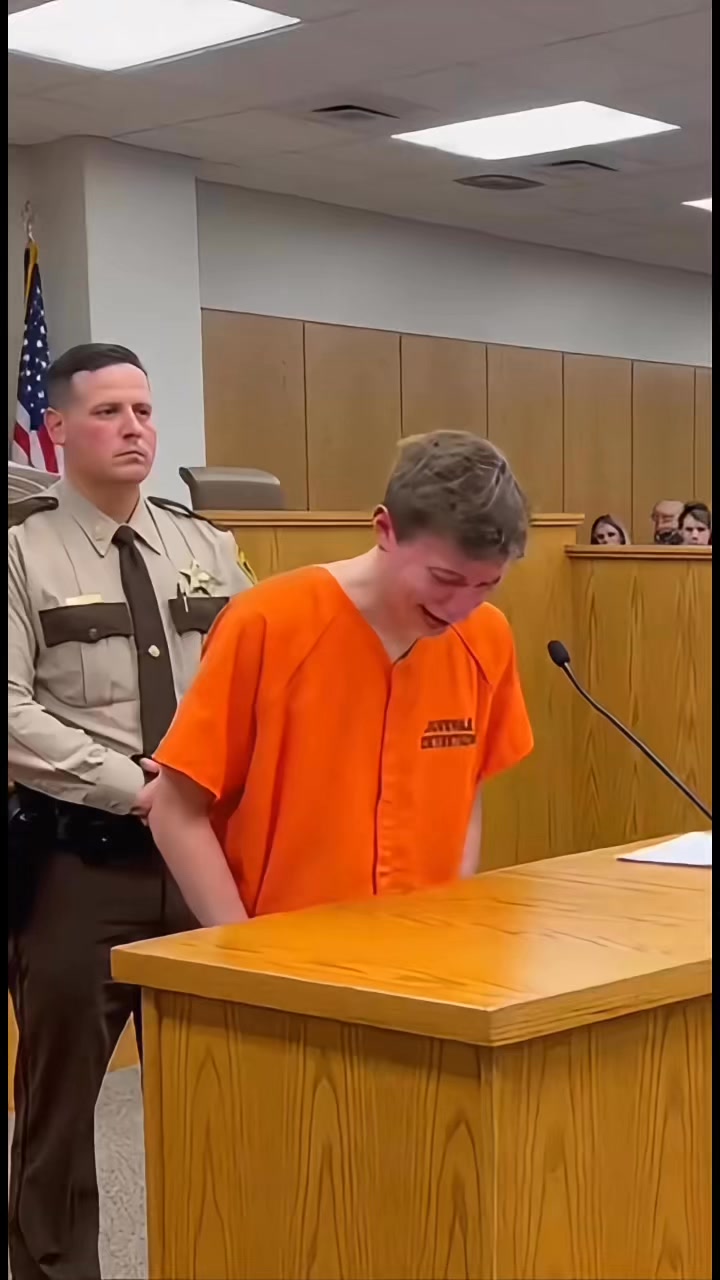
The room didn’t erupt.
There was no shouting. No chaos. No dramatic outburst.
Just silence.
A teenage boy stood in front of the judge, shoulders tense, hands unsteady, trying to hold himself together as the final words were spoken: 35 years.
For a moment, it didn’t seem real.
You could see it in his face—the pause, the blink, the slow realization as the meaning settled in. Thirty-five years wasn’t just a number. It was time. Most of his youth. Most of his future. Moments he hadn’t lived yet, now slipping out of reach before they even began.
The courtroom felt different after that.
Still.
Heavy.
Even those who had come prepared for the outcome seemed affected by the weight of it. Family members sat frozen, some holding back tears, others unable to look up. The kind of silence that says more than words ever could.
What made the moment so powerful wasn’t noise—it was the lack of it.
No anger. No resistance.
Just emotion.
 When Justice Meets Youth
Cases like this raise difficult questions that don’t have easy answers.
On one hand, the justice system is built to hold individuals accountable. Serious actions carry serious consequences, regardless of age. The law exists to protect others, to establish boundaries, and to respond when those boundaries are crossed.
But on the other hand, there’s something undeniably complex about youth.
Teenagers are still developing—emotionally, mentally, and psychologically. Decisions made in a moment can carry lifelong consequences. And that raises a question many people struggle with:
 Should age change how we judge actions?
 The Debate Around Change
There is a growing conversation around the idea that young people are capable of change in ways adults may not be.
Research often points to:
- Ongoing brain development during teenage years
- Increased impulsivity and risk-taking behavior
- Greater potential for rehabilitation over time
Because of this, some argue that long sentences for young offenders may not always leave room for growth or redemption.
Others, however, believe that accountability must remain firm—especially in cases involving serious harm.
And that’s where the tension lies.
 A Moment That Stays With You
What makes scenes like this so impactful isn’t just the legal outcome—it’s the human reality behind it.
A young person standing at a turning point.
A courtroom full of people witnessing it.
A future, suddenly redefined in seconds.
For many watching, the moment lingers not because of what was said, but because of what it represents.
The weight of decisions The permanence of consequences The question of whether a life can still change direction
 Questions That Don’t Go Away
Situations like this leave people divided—and thoughtful.
- Was the sentence fair?
- Should youth be treated differently under the law?
- Can someone truly change over decades?
There are no simple answers.
But moments like this force us to confront them.
 Final Thought
The courtroom eventually moves on.
The case closes. The room empties.
But for the person at the center of it, everything has changed.
Not loudly.
Not dramatically.
Just quietly, in a single sentence that echoes far beyond the walls of that room.
And for those who witnessed it—whether in person or from afar—it becomes a moment that stays with you.
Because sometimes, the most powerful reactions…
are the ones that make no sound at all.